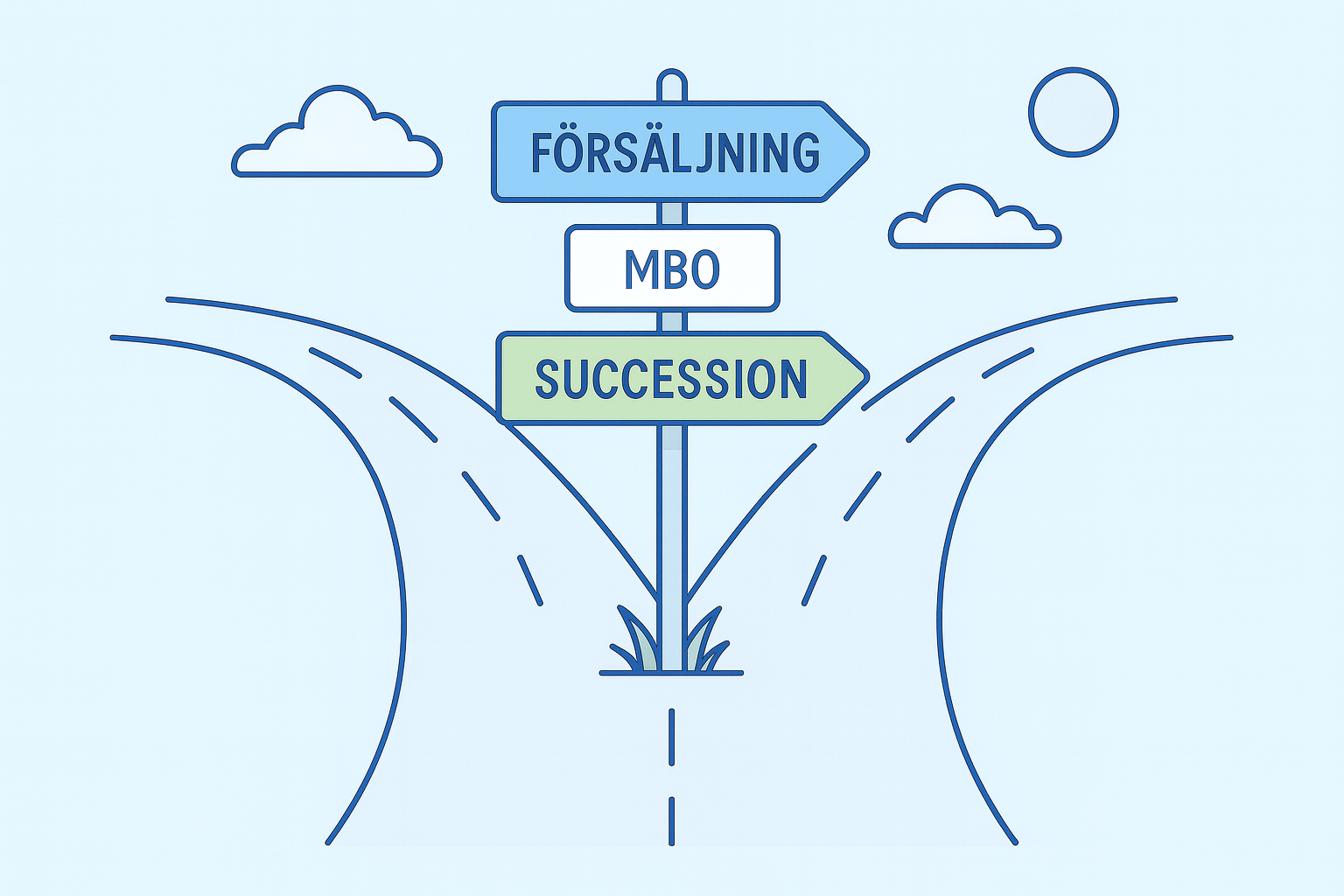
Why Many Swedish Companies Are Difficult to Sell


Why Many Swedish Companies Are Difficult to Sell
In Sweden, there are many profitable and growing companies that should be attractive to buyers. Yet a large share of planned business sales are terminated early in the process. For many entrepreneurs, it is difficult to understand why a company that is performing well is not easy to sell.
This pattern is repeated in M&A processes both in Sweden and internationally. Forbes describes how high-growth companies often fail during ownership transfers because revenue and profitability do not necessarily reflect the company’s actual value or risk profile.
The same problem exists in the Swedish market, where many companies are heavily dependent on their owners and lack clear structures and processes. To understand why profitable companies can be difficult to sell, one must look at the factors that influence value, risk, and buyer decision-making.
Owner Dependence – The Main Reason Companies Don’t Sell
One of the most important considerations in a business transfer is that the company must be able to continue developing positively even without the current owner. In many Swedish SME companies, the owner is the person who:
- Manages customer relationships
- Drives sales
- Holds key operational knowledge, often undocumented
- Governs the company and makes critical decisions
This significantly increases perceived risk for buyers. International studies on succession— including a German study on responsible succession —show that strong owner dependence is one of the most common reasons for low valuations and failed transactions. This is particularly common in Sweden. When critical components of the business “exist in the owner’s head,” uncertainty is created, which directly impacts valuation.
Insufficient Documentation – A Frequent Issue in Due Diligence
Many companies thrive thanks to quick decisions and informal processes. But in a business sale, the buyer must be able to verify everything.
Common deficiencies that arise during due diligence include:
- Missing or outdated contracts
- Undocumented internal processes
- Historical data stored across different systems
- Knowledge transferred verbally rather than documented
Forbes highlights lack of documentation as one of the primary reasons why due diligence processes collapse. This issue is common internationally but becomes especially visible in Sweden, where many owner-led businesses are built for operational efficiency rather than external scrutiny.
Without clear documentation, buyers struggle to assess risk, making it difficult to justify a reasonable valuation. The result is often price reductions—or, in the worst case, a terminated transaction.
Customer Concentration – A Central Issue in Business Valuations
Another common reason why profitable and well-managed companies are difficult to sell is high customer concentration. Many Swedish companies rely on a single customer for a substantial share of their revenue. This may feel normal and manageable for the owner, but it is risky for a buyer evaluating a potential acquisition.
An international analysis of IT and service companies shows that customer concentration is one of the leading reasons business sales fail.
Buyers always ask the same question:
What happens to earnings if this customer leaves?
The greater the dependency, the higher the perceived risk—resulting in a lower valuation.
Lack of Preparation – One of the Biggest Risks in Swedish M&A Processes
Due diligence processes have become significantly more comprehensive and data-driven in recent years. Requirements for structure, internal controls, contract management, and data quality have increased—and continue to do so.
Despite this, many Swedish companies begin preparing for a future business sale far too late. In some cases, preparations start only a few weeks before a Letter of Intent is signed and due diligence begins. A report from Mondaq shows how modern due diligence processes have become both broader and deeper.
Missing or insufficient preparation often leads to:
- Prolonged processes
- Increased advisory costs
- Greater risk that the buyer withdraws
- Weaker commercial terms
In business sales, thorough and early preparation is one of the strongest success factors.
FLB Partners’ Approach – How We Make Companies Sellable
FLB Partners works with exit readiness to help build companies that withstand scrutiny and appeal to buyers. Our focus includes:
- Identifying risks before the buyer does—and resolving them
- Building a due-diligence-ready structure that reduces uncertainty
- Clarifying and verifying the company’s underlying value
- Reducing owner dependence by strengthening the organisation and processes
- Ensuring the business is predictable and scalable from a buyer’s perspective
This work—more than market conditions, timing, or financial results—often determines whether a deal completes and under what commercial terms.
Conclusion: With Proper Preparation, Most Companies Are Sellable
Many Swedish companies fail during the sale process despite strong development and profitability. The reason is rarely their earnings, but rather their structure, documentation, and dependence on the owner. With proper preparation, these obstacles can be addressed, risks reduced, and value clearly demonstrated in a way that aligns with buyer expectations.
When well-prepared, a good company becomes a sellable company.
Want to learn more about how to maximise your chances of a successful business sale?Contact FLB Partners, and we’ll guide you through the preparation phase.